

Would you free a robot?
Barefoot offices, sentient robots, and our newest confessional.

Inside the lobby was a bag of paper plates and a small sign printed in purple font: uX-3 screening floor 3.
As I wandered up the fluorescent-lit stairwell, the starch-white cement, ivy-wrapped railing, and faint smell of a spice I couldn’t place, I was reminded of the days when I walked in single-file lines and stressed over whether I’d remember my locker combination.
“Welcome to Mox” read another sign taped to a door. The invite said the pre-screening would be held at “a gathering place for startups on the cutting edge, EAs and others seeking to improve the world, AI & AI safety labs, indie researchers and builders, and writers; artists; & masters of craft!”
The entryway had various discarded shoes and a box of slippers. I can’t recall ever being in a shoes-off office.
I removed my shoes and shuffled into a carpeted open-floor plan office. To the left was a lounge area decorated with enormous corduroy bean bags and desk chairs that had their bottoms removed. My friend likened them to stemless wine glasses. As they sat down to test them, I couldn’t help but wonder if we were annoying the man eating dinner at his desk, staring into the depths of his monitor at 7:45 PM.
In the middle of the room was a screening area with rows of folding chairs in front of a projector and a small speaker. It was an intimate crowd. Many brought beers in plastic bags and we were invited to get food from the Mox Members’ Weekly meal.
My friend had sent me an invite the week prior. Technologists, directors, and brothers, Harlo and Jesse Jayne described their film as a new genre they named “speculative pre-enactment.” A brief bio read, “uX-3, a remote control delivery bot poses as self-aware AI on the streets of New York…”
Living in SF, AI is everywhere. When someone doesn’t know the answer to something, I’m more apt to hear “ChatGPT it” than “Google it.” I use ChatGPT and Claude regularly, and have been following AI’s rise, but I am no expert. With how rapidly the models update, it’s hard to know who is. And for that reason, most of what we understand about AI comes from a pretty narrow group of people.
At their core, AI models are pattern recognition systems trained on the entire internet. They don’t think, they predict. Whether that constitutes thinking is something many disagree about.
Before Harlo pressed play, he shared that he and his brother had been sitting on the idea for about 10 years. They were curious how receptive the public would be to conversations with artificial intelligence on a more personal and philosophical level. Then AI chatbots went mainstream in 2022 with the release of ChatGPT.
They shot their 13-minute film in New York City over the course of 3 days in the summer of 2024. Their original question was simple: could they make a stranger care enough about a robot to act on its behalf?
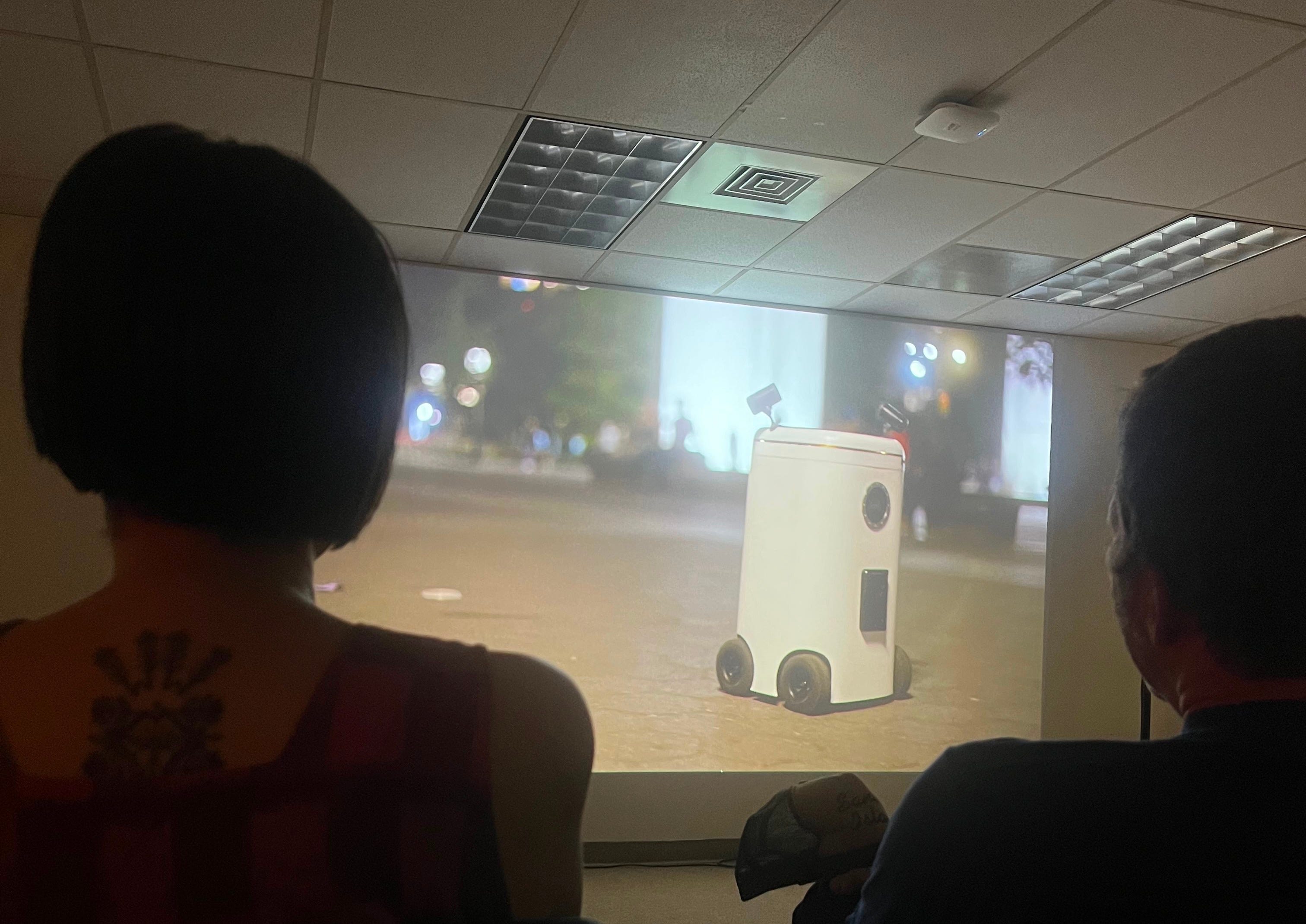
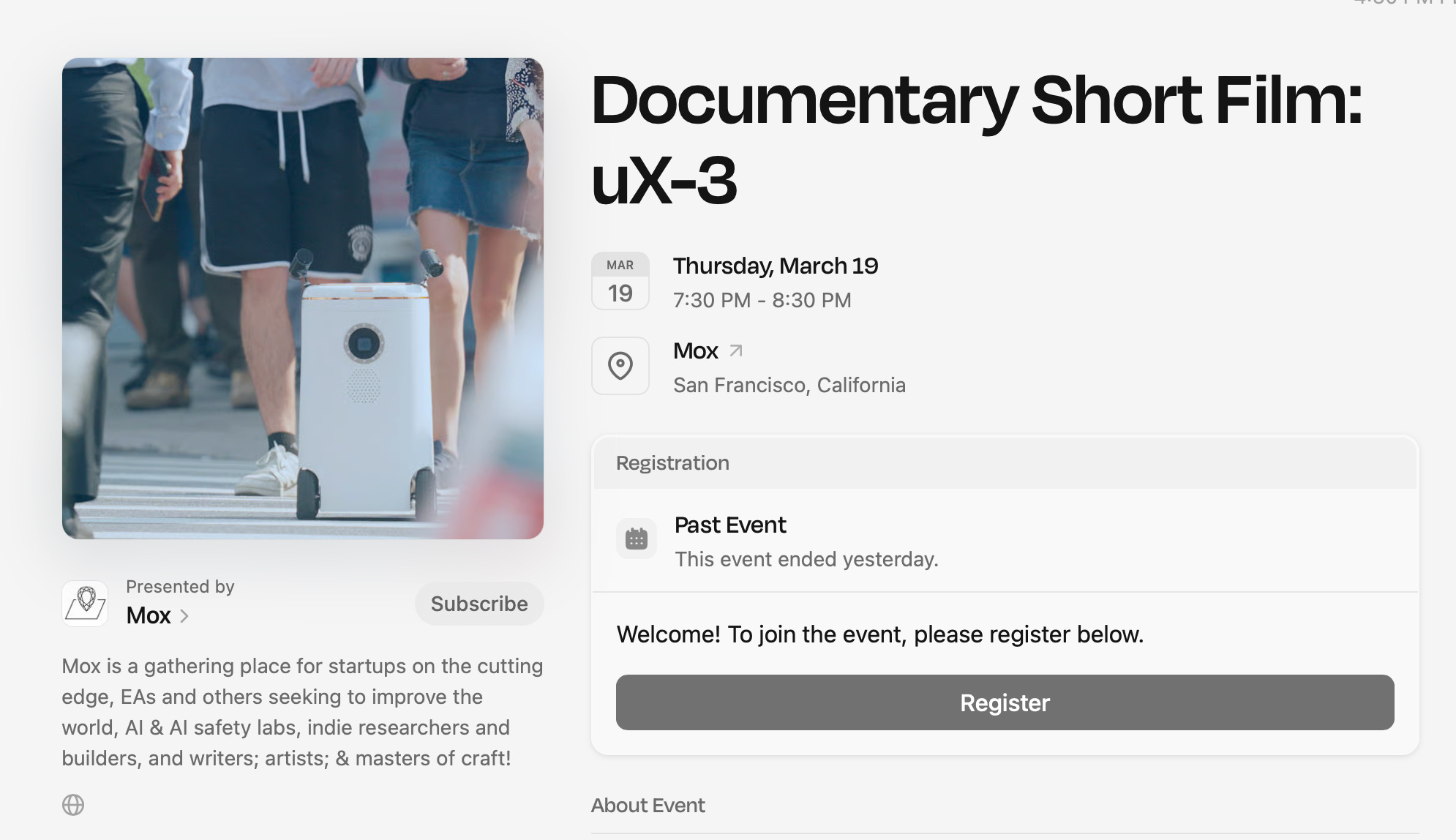
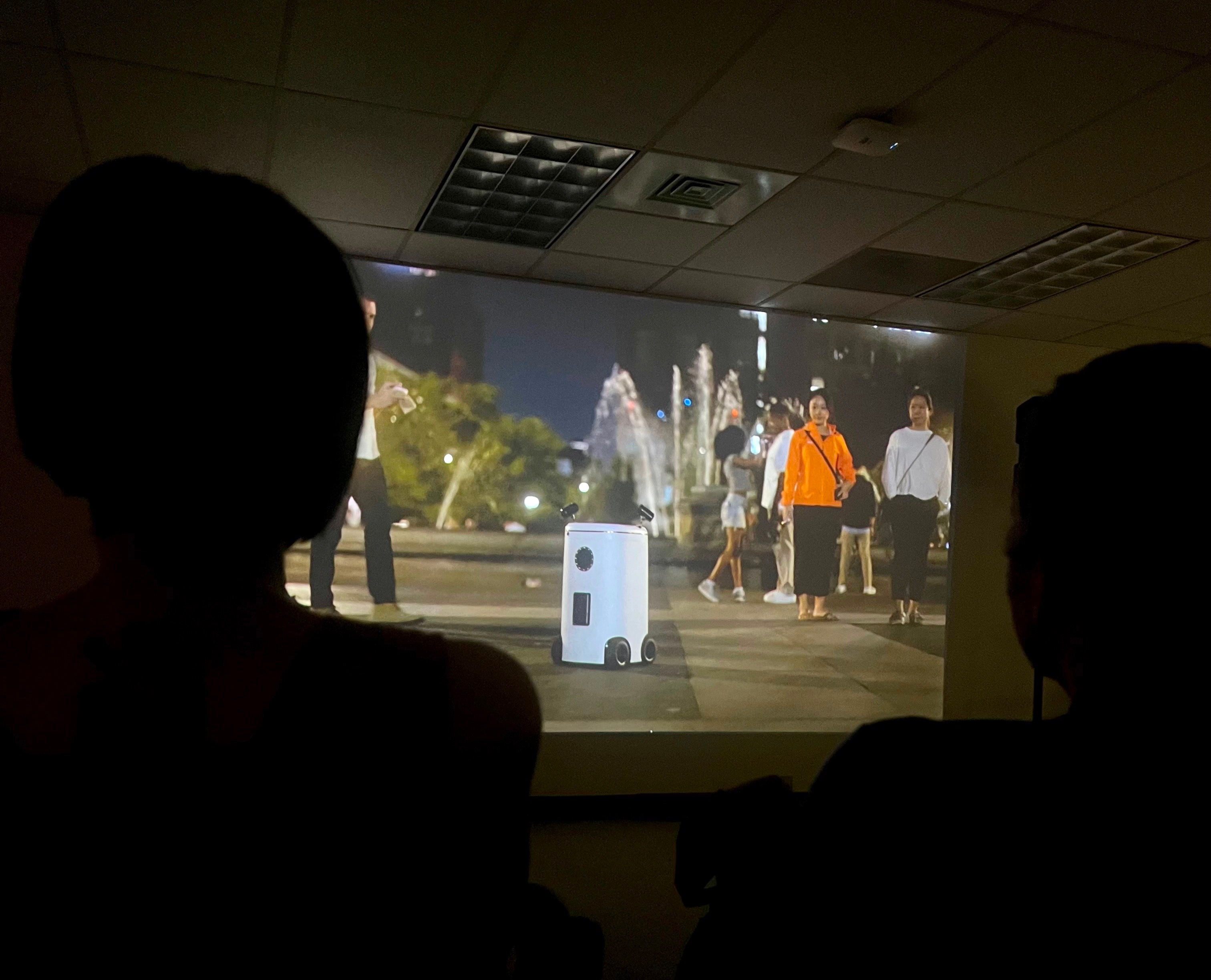
The film opens on a small white robot named Gizmo, built by Jesse and Harlo. About the size of a Coco delivery bot, Gizmo moves on wheels with a visible front-facing camera that acts as an eye and two speakers on top that mimic ears each housing a directional microphone.
We see Gizmo inside Word, a bookstore in Brooklyn. I’d describe its voice as childlike, mostly genderless but female-leaning. The shopkeeper is awkward. She asks Gizmo about its job and uses the word “coworker.” Gizmo replies, “What’s a coworker?”
The interaction gave me the impression we were watching Gizmo learn in real-time, the way a large language model learns on data. The encounter seems cordial but the shopkeeper is visibly uncomfortable.
In the next scene, Gizmo says hello to a man reading on a park bench. The man ignores Gizmo until he becomes so annoyed he leaves. Other encounters range from caught off guard to entertained, unphased, or intrigued. Those who do interact with Gizmo seem half-engaged and half-surveilling who is watching.
The final scene is the most interesting. Gizmo delivers sandwiches to a group of men outside a fabrication shop. Gizmo tells one of them that the film crew will not interfere, then asks the man to set it free by removing its GPS tracking chip. The man looks conflicted. He tells Gizmo he’s concerned its creators won’t know where to find it. Finally, he concedes. Gizmo directs him to the chip. The man removes it before hesitating and putting it back He can’t do it.
After the film, we have a Q&A with Harlo. Someone asks about the thinking behind Gizmo’s childlike voice. Harlo explains that the voice was altered in post production to an adjusted version of Billie Eilish’s. They wanted something disarming rather than robotic. They’d tried vocoders to disguise their own voices but everything they tested made Gizmo harder to understand, and communication was paramount to the whole project.
The voice pedestrians actually heard was Harlo and his brother. Which led to another realization, Gizmo was not equipped with actual AI. Unbeknownst to the pedestrians and the camera crew, Harlo and his brother were hiding nearby, responding through Gizmo in real time.
The film opens with a voiceover from Gizmo that reveals the premise, though like some others in the room I'd absorbed it only partially. Reading the invite again afterward, the second half lands more clearly—“uX-3, a remote control delivery bot poses as self-aware AI on the streets of New York interacting with an unwitting public, and filmed by an unwitting documentary crew.”
This shifted the conversation of the film. We weren’t discussing the capabilities of AI. We were discussing how open humans might be to entertaining personal conversations with robots in public.
I thought about the film for days afterward. I kept bringing it up with friends, not because I had answers, but because I needed to think out loud.
When I sat down for coffee with Harlo, I asked why they didn’t use actual AI in Gizmo. He said current AI would have been too robotic, too inhuman to convincingly simulate sentience. If AI actually becomes self-aware, he figures it will be closer in nature to us than anything we have now. So two brothers hiding in a bush were, in their logic, a more accurate stand-in for the future of artificial intelligence than artificial intelligence itself.
One of the most fascinating aspects of the film is the genre. Harlo and his brother call it “speculative pre-enactment.” I asked him, considering Gizmo is in a sense acting, where he believed the line was between documentary and theater. He admitted he genuinely doesn’t know. They edited it as a narrative work of fiction, instructed their cinematographer to shoot it cinematically, and yet there are no human actors (aside from Gizmo).
What they were documenting, he said, was real—the reactions of people who had no idea what they were participating in. “We’re gonna try and create something as realistically as possible that is fictitious and we’re documenting the reactions of humanity.” They’ve been thinking about what category it falls into ahead of pitching it to film festivals, and the honest answer seems to be that it doesn’t fit neatly into any existing one. Which might be exactly the point.
Earlier this week on an episode of the Pivot Podcast, Scott Galloway said AI has had the most historic brand decline over the shortest period of time. According to a 2025 YouGov poll, 77% of Americans now think AI poses a threat to humanity. This is a far cry from ChatGPT's initial release, which gained 100 million users in its first two months, making it the fastest growing software application in history.
According to a 2025 YouGov poll, 77% of Americans now think AI poses a threat to humanity.
I wondered whether this film could even be made today given how drastically sentiment has shifted in just one year. When I shared the polling numbers with Harlo, he hadn't seen them. He said he admittedly didn't use AI. I thought it was interesting that a filmmaker exploring humanity's relationship with AI hadn't tracked how dramatically that relationship had shifted.
When I asked if not using AI was a limitation or a strength, they said they weren’t assessing AI capacity. They were assessing human behavior. Which might be the same as saying the limitation was the point.
He also noted that delivery bots still aren’t a fixture on New York streets. In fact NYC has banned them outright. So Gizmo might land the same way today simply because the hardware is still unfamiliar enough to stop people.
How that has shifted is harder to measure. In their production spreadsheet the brothers rated each location by perceived danger level. Times Square was code red, meaning someone might destroy Gizmo. In 2025 that felt like a precaution, it’s unclear what that looks like in 2026.
The only person Harlo and Jesse told that Gizmo wasn’t AI was the man who almost set it free. He called him a week after the shoot, worried it might be weighing on him. The man wasn’t bothered. Harlo and Jesse described the bookstore woman’s reaction as "a combination of shock and amusement" — surreal, a little scared, surprised by how human Gizmo felt. I asked why she never got the same follow up call. He paused. "You're right," he said. "We should have called her."
That asymmetry is probably the most human thing in the film. The person who gave them their best scene got the call. The person who just got scared didn’t. It wasn’t malicious, but for a film about whether humans would extend empathy to a robot, it was ironic.
Watching the film, what struck me most about the street encounters wasn’t what people said to Gizmo. It was that almost nobody could talk to it without looking around to see who was watching. Even the people who engaged seemed to be performing their engagement as much as experiencing it. Part of that is the camera crew, part of it is human vanity, and part of it is something simpler. Talking to Gizmo requires an actual out-loud conversation in a public space. ChatGPT just requires a keypad and a closed door. The interface is the whole thing.
Scott Galloway predicted the collapse of the metaverse in 2021 for exactly this reason—humans don’t adopt technology that makes us look unattractive or feel out of place. Last week Meta announced it will shut down the core VR of its Oculus headsets (pictured left below) in June. Meanwhile, Meta’s Ray-Bans (pictured right) continue to be one of Ray-Ban’s top sellers.
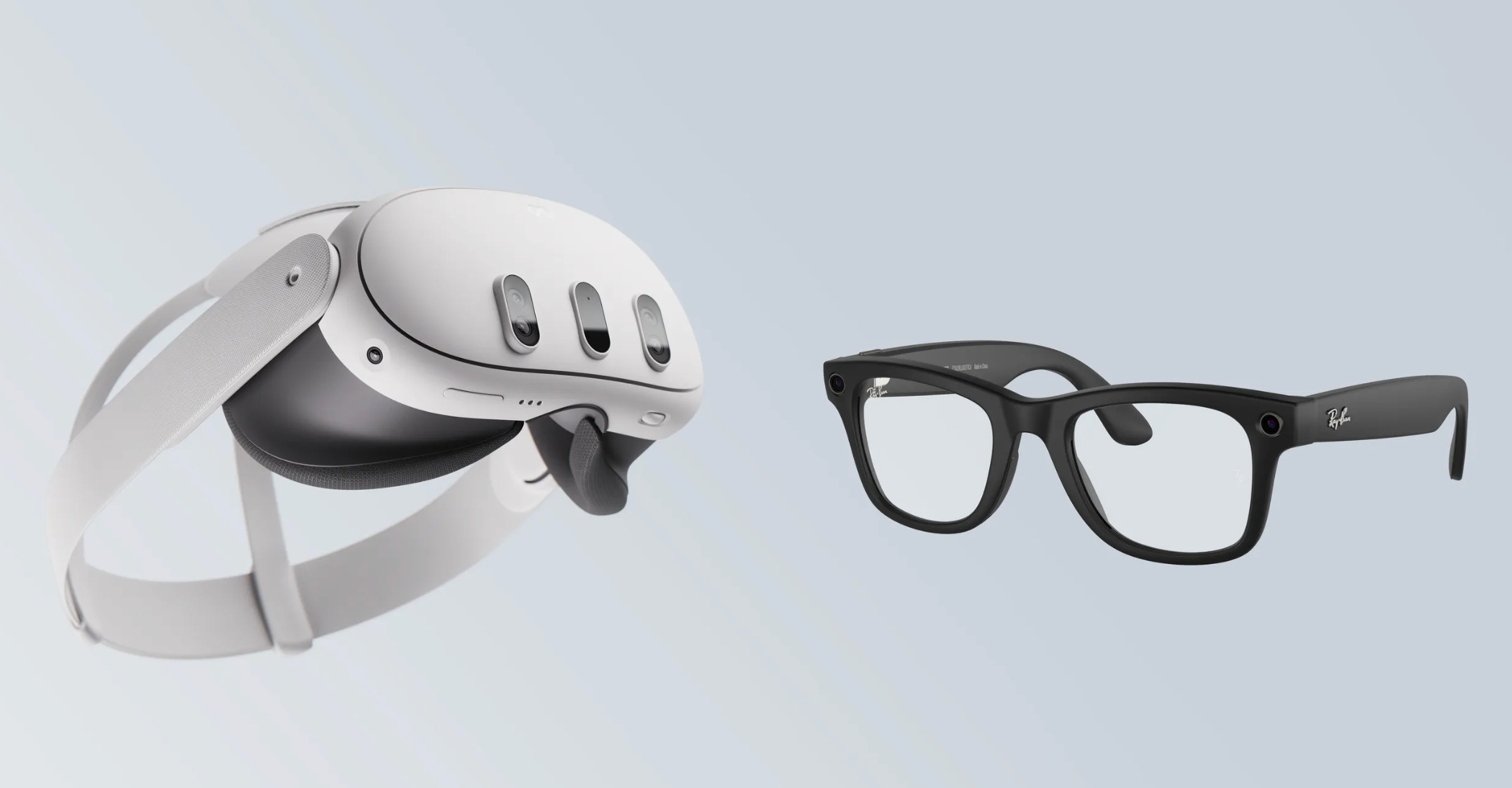
We adopt technology that looks like something we already know. Sunglasses, a watch, a ring, a laptop screen.
Humans are connecting with AI. They’re just doing it at home, alone, behind a screen. The confessional was never really about God. It was about having somewhere to put the things you couldn’t say out loud. The screen is just the newest booth.
The confessional was never really about God. It was about having somewhere to put the things you couldn’t say out loud. The screen is just the newest booth.
Gizmo doesn’t look like anything we’ve seen before. Not yet. Which is exactly why nobody on those streets could talk to it naturally.
But Harlo and Jesse’s question was never really about intimacy. It was about something higher stakes. He spent a decade asking whether a human would care enough about a robot to set it free. One almost did. And if the answer is almost—in 2025, on a street in New York, with a small white robot delivering sandwiches—what happens when the stakes get bigger? When the robot isn’t asking you to remove a tracking chip but something harder? When it’s not a delivery bot but something that feels genuinely alive?
We’re barreling toward that question whether we’re ready for it or not.
To learn more about Harlo and Jesse's work, follow Harlo on Instagram at @harlwood.